THE CRY (4)

To Rev. Russo s.j.
(4)
4
ORIGINAL SIN
That night Bê did not telephone Paris immediately.
He allowed the telephone to remain untouched upon the table beside the old New Testament, the cold tea, and the fountain pen whose ink had dried long ago. Outside, there was no rain, though the air carried that damp coldness peculiar to the final hours before dawn. He sat within the old armchair, his legs beneath the blanket, staring at his own reflection in the darkened window.
The reflection increasingly resembled another man.
A man who had nearly completed his life. A man who had quarrelled with every ideology imaginable, mocked religion for decades, and yet now found himself studying the New Testament as though it were an ancient map of humanity’s oldest fear.
He opened the first pages of Genesis.
Adam. Eve. The serpent.The Tree of Knowledge.The forbidden fruit.Eden.He read several lines before smiling faintly to himself.
“Bien ficelé…”
Everything tied together with extraordinary elegance. A story complete in structure: innocence, fall, sin, punishment, redemption. An immense symbolic architecture too beautiful for even an old unbeliever to dismiss entirely. Precisely because it was beautiful, it invited suspicion. And precisely because it invited suspicion, it became even more beautiful.
He glanced at the clock. Paris must already have been approaching dawn.
This time Father Russo answered only after many rings.
“Allô…”
“You remain alive?”
“If you continue asking that question every night, eventually it will become irritating.”
“Then you are definitely still alive.”
“Bê, it is barely five in the morning here.”
“An excellent hour for discussing Original Sin.”
Several seconds passed.
“Mon Dieu…”
“Do not summon Him too quickly. I intend to interrogate Him through you.”
“You are a liturgical catastrophe.”
Bê smiled faintly and drew the blanket slightly higher across his knees.
“Tell me something, Father.”
“Yes?”
“How does the modern Vatican truly understand Adam and Eve?”
Russo shifted in his chair.
“You intend once again to destroy Christianity?”
“No. I intend to save it from laziness.”
“That sentence itself sounds dangerous.”
“I ask very simply. Darwin arrived. Evolution is correct. Humanity did not descend complete from Heaven like plaster statues in provincial churches. Therefore who exactly were Adam and Eve?”
Father Russo remained silent for some moments. Bê could hear the faint sound of a lighter.
“Modern theology,” Russo said carefully, “does not necessarily require Adam and Eve to be understood as literal historical individuals in the simplistic sense.”
“Voilà.”
“Do not voilà too quickly.”
“So they are symbolic.”
“One could say rather a symbolic narrative.”
“Très bien.”
Bê smiled faintly.
“Then Original Sin itself becomes symbolic?”
Silence again.
Bê sat slightly straighter.
“You see the difficulty, Father. This is where the architecture begins loosening its own ropes. If Adam and Eve are symbolic, then the forbidden fruit is symbolic. If the fruit is symbolic, then Original Sin becomes symbolic. And if Original Sin becomes symbolic, what exactly did Christ descend to redeem?”
Paris became utterly still. At length Russo answered.
“You are asking an extremely serious theological question.”
“I know.”
“And asking it in a profoundly insolent tone.”
“Sometimes insolent questions are the only ones capable of preventing theology from falling asleep.”
Father Russo laughed softly despite himself.
“Very well. Then tell me what you think Original Sin actually is.”
Bê did not answer immediately. Outside, beneath the faint light above the garden, a dry leaf rested motionless upon the stones.
Finally he spoke.
“I do not think Original Sin has anything to do with eating an apple.”
“Scripture never mentions an apple.”
“Excellent. That rescues us from unnecessary botany.”
“Continue.”
Bê rested one hand upon the old New Testament.
“I think Original Sin began the moment the ape understood that it would die.”
The silence from Paris deepened so completely that Bê briefly wondered whether the line had disconnected.
Then Russo spoke very quietly.
“You return once more to Shanidar.”
“No. Tonight I connect Shanidar to Eden.”
“You intend to unite them?”
“Of course.”
Bê lowered his gaze towards his own hands. Thin skin. Blue veins. Brown marks left quietly by age beneath the lamplight.
“An animal that does not know it will die still lives in Paradise. It hungers and eats. Fears and flees. Mates. Sleeps. Exists entirely within the present moment. No guilt. No history. No testament. No cemetery.”
Father Russo breathed softly.
“And man?”
“Man is the animal expelled from the present.”
The sentence entered the room with almost physical weight.
“He knows he is naked,” Bê continued. “He knows he is finite. He knows his mother will die. He knows his child may die. He knows he himself will vanish. From that moment Eden ends.”
Russo answered slowly.
“The Tree of Knowledge as reflective consciousness.”
“Exactly. Consciousness becoming aware of itself within time.”
“And discovering death.”
“Yes. Discovering death.”
Outside, the wind moved faintly through the trees.
After a long silence Russo spoke again.
“And yet in theology Original Sin also concerns freedom, disobedience, rupture with God.”
Bê nodded to himself.
“Yes. But how is that rupture experienced? Through the loss of unconscious belonging. Humanity awakens. It realises itself separate. Vulnerable. Mortal. It can no longer dissolve peacefully into existence.”
“You are transforming theology into anthropology.”
“No. I am returning theology to the ageing body sitting in this chair.”
Father Russo laughed softly again, though now without mockery.
“Remember,” Bê continued, “the Vatican eventually had to reconcile itself with evolution. Humanity emerged from primates. Fine. But in order to preserve the soul, theology imagines some mysterious leap. A moment when God breathes spirit into the ape. Et voilà, the ape becomes man.”
Father Russo laughed more openly.
“You describe theology terribly.”
“But understandably.”
“Far too understandably.”
“And beautifully.”
Paris fell silent again.
“I am not mocking the image,” Bê continued more slowly. “I find it extraordinary. An animal rises from the forest, gazes upon a corpse, and suddenly realises that one day it too will lie motionless beneath the earth. If God truly breathed spirit into the ape, perhaps that breath was not merely reason.”
Russo answered softly.
“But terror as well.”
Bê closed his eyes briefly.
“Yes. Terror. And love also. Because if love did not exist, the death of another creature would never wound us.”
They remained silent for a long while.
This silence differed from all the earlier ones. There was no humour left inside it. No desire to win. Only two old men at opposite ends of the world contemplating one of humanity’s oldest fractures.
Then Bê spoke quietly.
“Perhaps Adam and Eve were never merely the first two humans.”
Silence.
“Perhaps they are every human being.”
Father Russo did not answer.
“Every child begins life within Eden. The child does not know death. It sleeps against the mother’s body like a creature still resting inside Paradise. Then one day it discovers that the mother will die. That it too will die. And at that instant it is expelled from Eden.”
From Paris came the sound of a very deep breath.
“You know,” Russo murmured, “that idea is not entirely distant from theology.”
“There you are again.”
“The Fall is not merely an event in the distant past. It repeats itself within every consciousness.”
Bê smiled faintly.
“So eventually even you agree that Adam is the autobiography of humanity.”
“That sentence is rather beautiful.”
“Write it down. Publish it in Christus.”
“I already told you. I am too old now for publication.”
“Then I shall place it upon Substack.”
“No thank you. I still hope to die in grace.”
Bê laughed softly.The room became quiet again. After some time he continued.
“Do you see now? From the instant humanity became aware of death, everything else followed. Civilisation. War. Money. Worship. Family. Art. Philosophy. Theology. Artificial intelligence. Every one of them merely an attempt to prolong the voice of an animal expelled from Eden.”
“And redemption?” Russo asked quietly.
Bê looked at the New Testament.
“What is redemption if not the promise that exile from Eden is not the final word?”
Outside the window a pale ribbon of dawn had begun appearing beyond the trees. Bê felt the heaviness behind his eyes, the slow fatigue of a body that had travelled almost to the end of itself. Yet he did not wish the conversation to end.
“Father.”
“Yes?”
“Christ descends into the world. Crown of thorns. Bitter wine. Pierced flesh. Physical death. Then resurrection after three days. All of this to redeem Original Sin.”
Father Russo listened silently.
“But if Original Sin is fundamentally the awakening of death-consciousness… then why exactly does Christ die?”
Paris became motionless. Bê spoke more softly now.
“Perhaps Christ did not die merely to settle some legal debt inherited from Adam.”
Silence.
“Perhaps He entered directly into humanity’s deepest terror.”
Father Russo still did not answer.
“So that when man dies, he no longer dies entirely alone.”
The sentence startled even Bê himself.
He did not know where it had emerged from. From intellect? From exhaustion? From old age? From decades of unbelief finally becoming weary? Or from some form of grace whose name he still refused to pronounce?
For a very long time Father Russo remained silent. Then at last he spoke quietly.
“Bê.”
“Yes?”
“That sentence lies much closer to the centre of Christianity than you realise.”
Bê laughed faintly.
“Oh, spare me. I should still like to preserve my reputation as an unbeliever.”
“You will preserve it. But unbelievers such as you are profoundly inconvenient for the Church.”
“Why?”
“Because you ask the questions many believers are too frightened to ask.”
Bê remained silent.
Outside, dawn had grown slightly brighter. His reflection upon the darkened glass had already begun fading into the approaching morning. Then Father Russo spoke again.
“In the theology of the Cross, God does not remain outside suffering. He enters it. He does not explain suffering from a safe distance. He does not send consoling memoranda from Heaven. He undergoes it.”
Bê answered almost in a whisper.
“So God does not answer death.”
Silence.
“God dies with humanity.”
Father Russo did not immediately reply.Then very softly:
“Yes.”
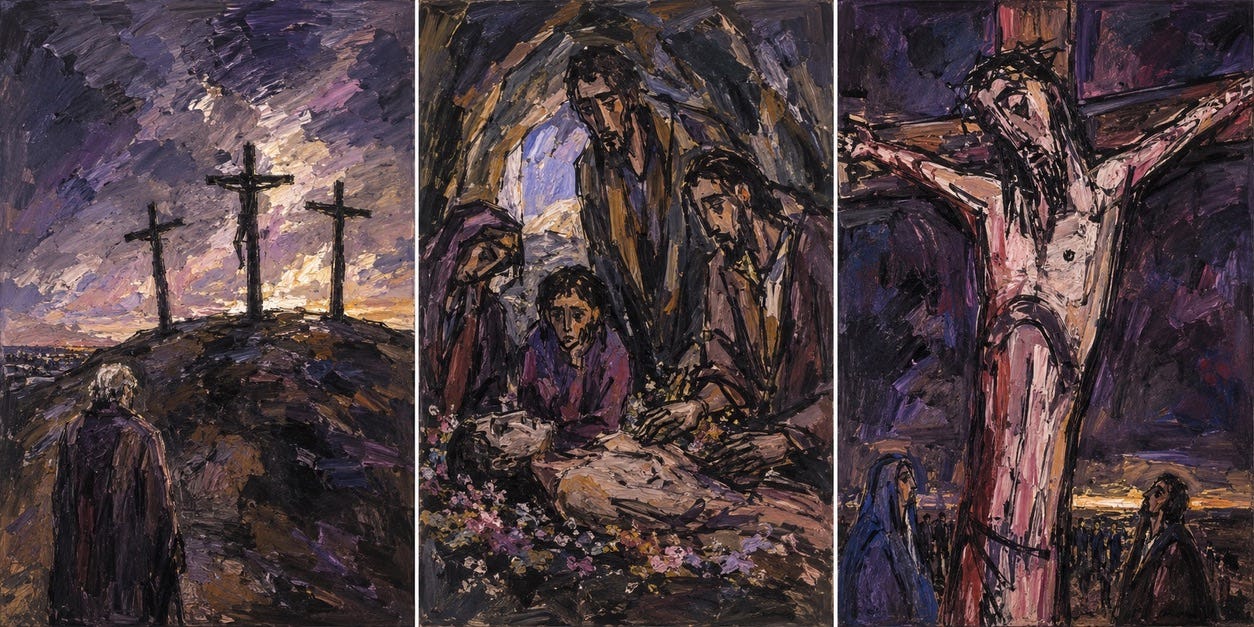
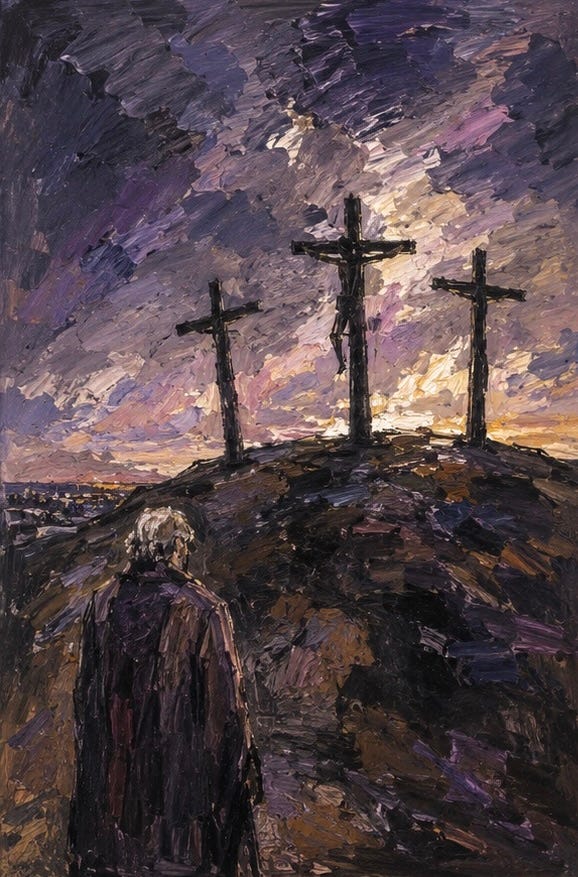
Bê sat motionless, one hand resting upon the old New Testament. For the first time in many years he no longer saw the Crucifixion merely as an elaborate theological system. Suddenly he saw something far simpler and far more unsettling, a figure entering humanity’s room of dying, not to lecture, not to resolve metaphysics, but simply to lie down beside mortal creatures within their terror.
Whether true or not, the image possessed a beauty almost painful to endure. Father Russo coughed lightly.
“My old friend… I must go and say Mass.” Bê glanced towards the clock.
“And I must finally sleep.”
“Will you manage it?”
“After dismantling Original Sin? Probably.”
“You dismantled nothing,” Russo replied quietly. “You merely made it hurt more deeply.”
“Theology ought to hurt sometimes.”
“And sometimes remain silent.”
“That part I have never mastered.”
“I know.”
They laughed softly together.
The laughter before dawn sounded different from laughter at midnight. Thinner. Gentler. As though it had already travelled through darkness and no longer wished to disturb the world.
“Bonne nuit, Bê
“Bonne messe, Father.”
The line disconnected.
Bê continued holding the telephone for several seconds before placing it down with immense slowness, almost as though afraid that too abrupt a movement might shatter the final fragile atmosphere of the night.
The room became silent enough for him to hear his own heartbeat. Steady. Persistent.
A flesh-made clock still functioning within a body approaching expiration.
Outside, the sky was slowly whitening beyond the trees. Not the radiant morning of youth, but a pale exhausted light, as though the world itself had only just returned from darkness after a long night of labour.
Bê closed the New Testament gently. The worn cover felt beneath his hand like the skin of another old being that had travelled through centuries of human sorrow.
And suddenly he understood why the image of the Cross had followed humanity for two thousand years without disappearing.
Not because mankind had discovered a perfect explanation for suffering. The older he became, the less he believed humanity had ever truly explained suffering at all. Theology failed before it. Philosophy failed before it. Science failed before it. Each merely changed the language of helplessness.
What human beings required was perhaps not explanation.
But companionship before death. Someone willing to remain beside them within the darkness.
When he was young, Bê had regarded Christianity as a brilliantly constructed architecture of salvation. Original Sin. Fall. Redemption. Heaven. Hell. Everything tied together with intimidating coherence. An immense metaphysical system erected around mankind’s fear of extinction. He had examined the entire structure with the ironic suspicion of a man who had read too much Darwin, Nietzsche, and Freud.
Yet old age alters many things. The older he became, the more he understood that Christianity survived not primarily through theological logic.
But through image.
A man nailed upon wood.
A dying body.
A voice crying:
“My God, why hast Thou forsaken me?”
The sentence was unbearably human. Too lonely.Too real.
Even God passes through abandonment.Even God passes through fear. Even God passes through physical death.
And perhaps this was why humanity could never entirely abandon the Cross.
Not because Christ explained death.
But because Christ died with mankind.
Bê remained seated for a very long time after that thought. He did not know whether he truly believed it. But he recognised within it a beauty so profound that it almost resembled grief.
Outside, dawn brightened slightly behind the trees, which now appeared like ancient figures waiting patiently beyond history itself.
Suddenly he thought of Shanidar. A Neanderthal bending over the grave of another forty thousand years ago. Perhaps even then humanity had already begun searching for someone willing to die beside it. Someone capable of whispering that the hole in the earth was not entirely meaningless.
Slowly Bê stood up. His knees hurt. His back hurt. His wrists hurt. The ageing body continued reminding him that every theology must eventually pass through flesh.
He switched off the lamp.
The sitting room sank into the pale grey light before morning. The cold tea. The old book. The armchair. The telephone. The darkened window. Everything remained motionless like small witnesses to a night during which Adam, Eve, Darwin, Golgotha, and Shanidar had all briefly occupied the same table.
Then Bê walked slowly towards the bedroom.
In Paris Father Russo was probably already dressing for Mass. In Massachusetts Bê lay down carefully beneath the blanket and closed his eyes.
Just before sleep overtook him, he heard his own sentence once more within the darkness:
God does not answer death.
God dies with humanity.
Bê smiled faintly to himself.
“Bien ficelé…”
And then he fell asleep like an old man who had succeeded in purchasing one more night against the void.
Review
THE THREE CROSSES
A Meditation on Death, Consciousness, and the End of Civilisation - By Pierre Nguyen
There are books that attempt to explain religion. There are books that attempt to dismantle it. And there are far rarer books that approach religion not as doctrine, ideology, or apologetics, but as an immense anthropological wound within the history of consciousness itself.
The Three Crosses belongs unmistakably to this third category.
At first glance, the work appears deceptively simple: a series of late-night conversations between two ageing intellectuals, Bê and Father Russo, unfolding between Massachusetts and Paris through insomnia, tea, cognac, cigarettes, theology, humour, and the growing awareness of mortality. Yet beneath this intimate conversational surface lies one of the most unusual meditations on death, civilisation, Christianity, and consciousness written in recent years.
The central brilliance of the manuscript lies in its refusal of simplistic positions. It is neither a religious defence nor an atheist attack. Bê no longer believes in the naïve theological certainties of his youth, yet neither can he dismiss religion entirely. Father Russo remains within the Catholic tradition, yet old age has stripped him of triumphalism. Their conversations therefore become something extraordinarily rare in contemporary intellectual writing: a dialogue after ideology.
What emerges gradually is a profound reinterpretation of Christianity through the lens of anthropology, mortality-awareness, and existential consciousness. The manuscript’s most original insight is its reframing of Original Sin not as moral transgression, but as the awakening of death-consciousness itself. Eden becomes pre-reflective animal existence. The Fall becomes humanity’s discovery of finitude. Civilisation itself emerges as a symbolic architecture erected against annihilation.
This movement reaches its philosophical summit through the astonishing connection between Genesis and Shanidar. By linking the biblical Fall to prehistoric burial consciousness, Nguyen creates a conceptual bridge between theology and paleoanthropology that feels both daring and strangely inevitable. The human being becomes “the animal expelled from the present,” condemned to live not merely biologically, but historically, symbolically, and mortally.
The prose itself deserves particular attention. Unlike much contemporary philosophical fiction, which often collapses into abstraction, The Three Crosses remains relentlessly embodied. Tea cools upon the table. Rain touches the windows. Old men cough after laughing. Morphine dissolves lucidity. Knees hurt. Sleep refuses to arrive. Mortality is never discussed from a safe theoretical distance. It inhabits the body.
This grounding in physical existence gives the work its emotional authority. The manuscript understands something many philosophical texts forget, death is not merely an intellectual problem. It is physiological, intimate, humiliating, and profoundly human.
Stylistically, the work belongs less to contemporary Anglo-American fiction than to an older European intellectual tradition. One senses distant echoes of Bernanos, Camus, late Unamuno, perhaps even fragments of Dostoevsky stripped of melodrama and rewritten after Darwin, Auschwitz, and neuroscience. Yet the voice remains unmistakably Nguyen’s own: weary, ironic, lucid, compassionate, and haunted by civilisation’s inability to resolve the terror of disappearance.
Several formulations within the text possess genuine philosophical power:
“Man is the animal expelled from the present.”
“Perhaps civilisation itself is merely symbolic architecture erected against death.”
And above all:
“God does not answer death. God dies with humanity.”
This final inversion may ultimately constitute the spiritual and intellectual centre of the entire work. Christianity here is no longer presented primarily as metaphysical explanation or juridical redemption. Instead, it becomes companionship before death. Christ does not solve mortality. He enters it.
Whether one agrees with the theology is almost secondary. The emotional and anthropological force of the idea is undeniable.
The Three Crosses is therefore not merely a meditation on Christianity. It is a meditation on why humanity itself cannot stop producing symbols against the void. Heaven, Hell, ancestors, reincarnation, Nirvana, resurrection — all become variations of the same existential struggle: how does conscious life endure the knowledge of its own extinction?
What makes the work remarkable is that it asks these immense questions without ever losing tenderness. Beneath the metaphysics lies the fragile intimacy of two old men speaking across the Atlantic while waiting, consciously or unconsciously, for death.
The result is a text at once philosophical, literary, theological, anthropological, and deeply human.
One leaves the book with the unsettling impression that the conversations between Bê and Father Russo are not merely private exchanges between two ageing intellectuals, but perhaps the final dialogue of an exhausted civilisation still attempting, through language and symbols, to negotiate its relationship with the void.