THE CRY (3)

To Rev. Russo sj.
(3)
3
WHAT IS HEAVEN FOR?
The following evening Bé telephoned Paris slightly earlier than usual. In Massachusetts it was barely eleven o’clock, though in Paris dawn had already begun approaching. Father Russo answered with a voice at once hoarse and strangely alert.
“You again?”
“I slept first tonight. Then woke deliberately in order to disturb you.”
“That itself sounds almost like a vocation.”
“The vocation of unbelief.”
“A remarkably persistent vocation.”
Bê laughed softly.
Outside the windows the Massachusetts night remained dry and motionless beneath a thin layer of cold. The tea still rested upon the table, though tonight there was no cognac. He wished to remain lucid for the question that had occupied him since the afternoon.
“Father.”
“Yes?”
“If one dies peacefully, one goes to Heaven. If one dies badly, one descends into Hell. Correct?”
Father Russo paused for several seconds before laughing quietly.
“You sound like a child in catechism.”
“No. I sound like an old man approaching death.”
“Very well. Ask.”
Bê drew the blanket higher across his knees.
“What is Heaven actually for?”
In Paris something touched lightly against a table.
“Pardon?”
“I am serious. What exactly is the purpose of Heaven? One sees the face of God. One experiences eternal joy. Amen. Then what?”
Father Russo laughed.
“You truly are a catastrophe for theology.”
“No. I am simply practical. Human beings become restless after two hours of sitting still. Yet Heaven proposes eternity. Endless eternity gazing upon God forever. Then what happens after the first million years?”
“You are imagining Heaven as a very large drawing room.”
“Well, church paintings encouraged the misunderstanding. Light. Angels. Celestial music. Saints standing in rows. I ask honestly, Father: after a million years, what does one do?”
Russo coughed lightly before replying.
“Heaven is not a geographical place.”
“Voilà. We have arrived at modern theology.”
“Allow me to finish.”
“Please retreat into metaphor at your leisure.”
“It is not retreat. It is depth.”
Bê smiled faintly.
“You speak like a Jesuit.”
“Heaven is communion with God, complete union with the source of being itself. No fear. No separation. No ego torn away from existence.”
Bê remained quiet for a moment.
“It sounds beautiful,” he said finally. “But rather abstract.”
“Because you wish Heaven to contain armchairs, wine, and Nana Mouskouri.”
“At the very least Nana Mouskouri.”
This time Father Russo laughed openly.
“The unbeliever intends to negotiate a musical playlist for eternity.”
“Of course. If eternity contains bad music, then eternity itself becomes Hell.”
Both men laughed for some time. The laughter crossing the Atlantic sounded thin and old, yet deeply genuine. Eventually Bé returned quietly to his question.
“And Hell?”
“You may as well continue.”
“Does Hell contain fire?”
Russo fell silent. Bê continued.
“If there is fire, what exactly burns? The soul possesses no flesh. How does one burn a soul? Does a burning soul produce smoke?”
“You are profoundly disrespectful.”
“I am asking seriously. As a child I feared Hell enormously. Eternal fire. Endless punishment. Later I studied physics and became irritated. Fire requires matter. What exactly is the soul? Energy? Consciousness? Memory? If the soul is immaterial, how does material fire burn it?”
Father Russo sighed.
“Modern theology no longer understands Hell as a physical furnace.”
“The Vatican retreats another step.”
“No. Hell is separation from God.”
“That still sounds abstract.”
“It means becoming incapable of love.”
Bê stopped smiling. The sentence entered the room quietly, but with enormous depth.
“Incapable of love?”
“Yes. A consciousness closed entirely within itself. A soul refusing grace. Refusing love. Refusing even the possibility of being loved.”
Bê stared at his own reflection upon the darkened glass.
“Gestas.”
“Perhaps.”
“Dying still angry.”
“Yes.”
“Dying still clutching the ego.”
“Yes.”
Bê remained motionless for a long time. Outside, no wind moved through the trees. The night itself seemed suspended around the house.
“So Hell is not God imprisoning man.”
Father Russo answered softly.
“Not entirely.”
“It is man imprisoning himself.”
“One could say that.”
“How extraordinary.”
“Do not become too enthusiastic. It remains a tragedy.”
“I know.”
Bê lowered his eyes towards his hands. Blue veins rose beneath the yellow lamplight. Suddenly he remembered moments of anger throughout his own life, moments when he had wanted victory more than reconciliation, moments when he had refused forgiveness and carried another human being within himself like a burning fragment of coal. If Hell truly meant losing the ability to love, then many people had already entered Hell long before death itself.
“Father.”
“Yes?”
“So Heaven is the end of fear, while Hell is the end of love?”
Father Russo paused.
“That is literary language. But it is not entirely false.”
“Then perhaps one need not die in order to enter either.”
“There may indeed exist seeds of Heaven and Hell already within earthly life.”
Bê laughed softly.
“You are slowly converting me.”
“No. You are merely becoming old enough to lose certain naïve certainties.”
Again silence settled between them.
In Paris Father Russo was probably gazing across grey rooftops washed by early rain. In Massachusetts Bé looked out towards the dark garden. Two old men standing at opposite ends of the world: one believing in God, the other no longer believing in the old manner, yet both aware that they were no longer discussing theology in abstraction, but the approaching fate of their own bodies.
After some time Bê spoke again.
“Do you know what irritates me?”
“What?”
“The modern Vatican softens everything.”
“You begin again.”
“I am serious. Once theology was perfectly clear. Heaven above. Hell below. Adam and Eve. Forbidden fruit. Original Sin. Christ dying for redemption. Believe and be saved. Everything tightly fastened together. Beautifully tied.”
“And now?”
“Now science arrives. Darwin arrives. Archaeology arrives. Neuroscience arrives. Suddenly the Vatican begins saying: Adam and Eve may be symbolic. Eden may be symbolic. Hell is not literal fire. Heaven is not a physical place. Everything becomes symbolic.”
Father Russo smiled faintly.
“You speak as though symbols were failures.”
“No. Quite the opposite.”
“Then?”
Bê sat straighter in his chair.
“I believe symbols may be humanity’s greatest invention.”
Russo said nothing.
“Human beings cannot survive through abstraction alone,” Bé continued. “Nobody dies peacefully because of a philosophical diagram. People require images. Crosses. Guanyin. Heaven. Hell. Ancestors. Altars. Some invisible hand capable of guiding them through darkness.”
“Symbols against the void,” Russo murmured.
“Yes. Symbols against the void.”
Bê lifted the cold tea and drank a small mouthful despite its bitterness.
“Religion itself may be sacred. But doctrine often becomes an immense symbolic structure permitting mankind to endure death.”
“That sentence is dangerous.”
“It is beautiful.”
“Dangerous precisely because it is beautiful.”
Bê smiled faintly.
“You fear I shall reduce Christianity to metaphysical poetry?”
“You have been doing precisely that for thirty years.”
“And yet you still listen.”
“Because poetry occasionally understands what doctrine explains too dryly.”
That sentence left Bê silent.
He looked at the old New Testament resting upon the table. The cover had become worn like ageing skin. He did not believe as Father Russo believed. Yet he could no longer mock that book. It had travelled through two thousand years of human tears. How many dying soldiers had clutched a crucifix before execution? How many mothers had prayed before the Cross? How many patients had stared at the face of Christ in hospital rooms while morphine slowly dissolved the world around them?
“Father.”
“Yes?”
“Perhaps humanity does not truly need to know what Heaven is.”
Silence.
“Perhaps it only needs to believe that death is not entirely meaningless.”
Paris remained silent for a very long time. Then Father Russo answered quietly:
“That is why faith exists.”
“And I would call it the reason symbols exist.”
“There remains a difference.”
“Yes. But perhaps less difference than I once imagined.”
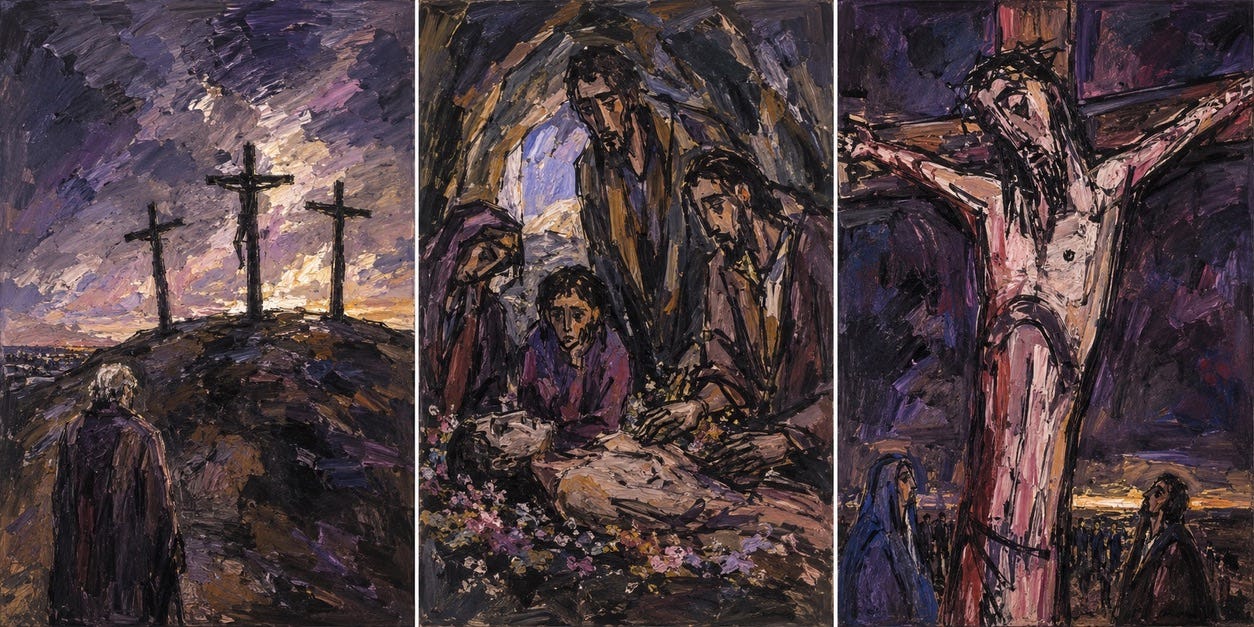
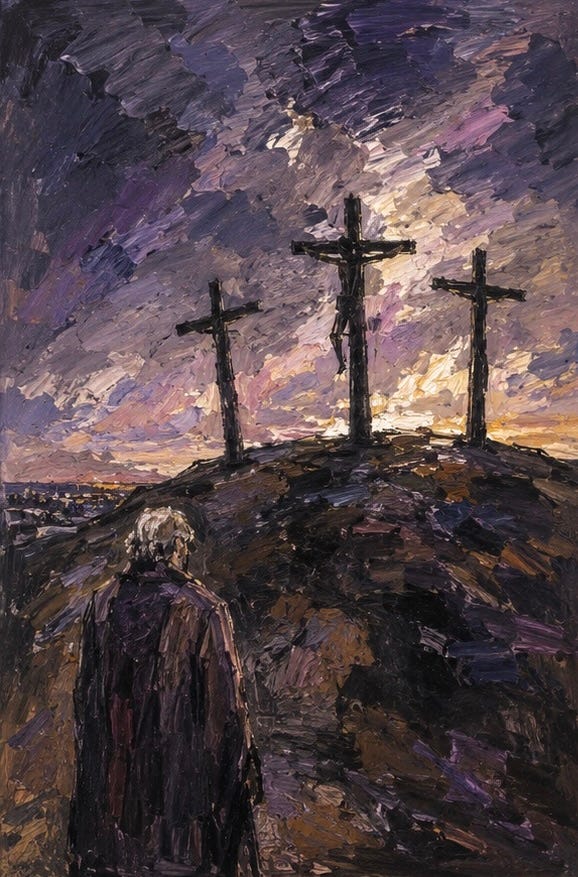
Outside, a faint wind moved through the darkness. The window trembled softly. Bê suddenly imagined the three crosses once more emerging somewhere behind the night. Christ in the centre. Dismas to one side. Gestas to the other. One man releasing. One clinging. One silent beneath the unbearable weight of human history.
“Father Russo.”
“Yes?”
“If Heaven means the end of fear… then perhaps anyone who dies peacefully has already passed briefly through Heaven before death.”
Father Russo breathed softly.
“Perhaps.”
“And if Hell means the inability to release the self… then many people carry Hell within them long before dying.”
“Perhaps.”
“What kind of Jesuit answers everything with perhaps?”
“The kind old enough to know that the living cannot speak with certainty about death.”
Bê laughed quietly.
“So theology finally learns humility.”
“Good theology must remain humble.”
“And bad theology?”
“Bad theology becomes the police force of God.”
Bê laughed so violently he began coughing.
“That sentence deserves publication.”
“I am too old to publish anything now.”
“Then I shall publish it on Substack.”
“Please do not drag me into digital purgatory.”
They laughed once again.
Then silence returned.
The Massachusetts night had softened. In Paris dawn must already have begun whitening the streets. Bê heard Father Russo moving papers, adjusting a chair, preparing perhaps for early Mass. Their conversations always followed the same rhythm, beginning in mockery, descending into metaphysical darkness, and ending with something ordinary, one man going to sleep while the other prepared for liturgy.
At last Father Russo spoke.
“My old friend, enough for tonight.”
“You fear I shall dismantle Heaven completely?”
“No. I fear you shall transform Heaven into a salon with Nana Mouskouri.”
“That would still be preferable to Hell.”
“Bonne nuit.”
“Bonne messe.”
The line disconnected.
Bê remained seated with one hand still resting upon the telephone. The room immediately expanded into silence. The cold tea, the old New Testament, the yellow lamp, and his reflection upon the darkened window remained motionless like minor pieces of evidence in some immense trial without judge or verdict.
He switched off the lamp.
Before returning to bed he turned once more towards the darkness of the sitting room and suddenly thought that if Heaven truly meant the end of fear, then perhaps tonight he had approached slightly nearer to it.