THE CRY (2)

To Rev. Russo sj.
(2)
2
A GOOD DEATH, A BAD DEATH
The following night Bê again found himself unable to sleep. Rain had passed across the garden earlier in the evening, leaving scattered droplets trembling upon the windows. The house seemed darker and colder than before. He sat once more in the sitting room, wearing a grey woollen jumper, his legs covered by the same blanket, listening to the faint sound of water dripping somewhere along the gutters outside.
A small glass of cognac rested upon the table beside him, only half finished. He glanced at the clock and telephoned Paris. Father Russo answered quickly this time.
“Allô…”
“You are still alive, then?”
“Barely. Tonight my back feels determined to murder me.”
Bê laughed softly.
“Voilà. Catholic grace.”
Russo laughed as well.
“And you?”
“I am drinking cognac alone like a failed aristocrat.”
“At least there remains some elegance in your decline.”
Outside, the wind moved quietly through the trees. After a long silence Father Russo spoke again.
“My old friend… yesterday you spoke of dying comfortably. I have continued thinking about it.”
“So have I.”
“What does a good death actually mean?”
Bê took a small sip of cognac before answering.
“It means not becoming too much of a burden to others.”
Father Russo immediately burst into laughter.
“That answer could only come from an Asian.”
“And yours could only come from a Catholic. Even death must possess dignity.”
In Paris a lighter clicked once more.
“In theology,” Russo said slowly, mourir dans la grâce means dying peacefully.”
“No,” Bê replied quietly. “Most humanity does not die peacefully.”
“Yes.”
“People die in intensive care units. Tubes everywhere. Morphine. Monitors beeping through the night. They die technologically.”
Father Russo remained silent.
“I do not think man truly fears death,” Bê continued.
“Oh?”
“Man fears an ugly death.”
Outside, the rain began again in fine drifting lines.
“What is an ugly death?” Russo asked softly.
Bê looked at his own reflection upon the darkened window.
“A humiliating death.”
Silence.
“A lonely death.”
Silence.
“A death reduced to medical machinery.”
Silence again.
“A death before one has spoken the final words one needed to say.”
He paused for a long time.
“And a death still filled with anger.”
The Atlantic line became completely still.
Bê drank another small mouthful of cognac.
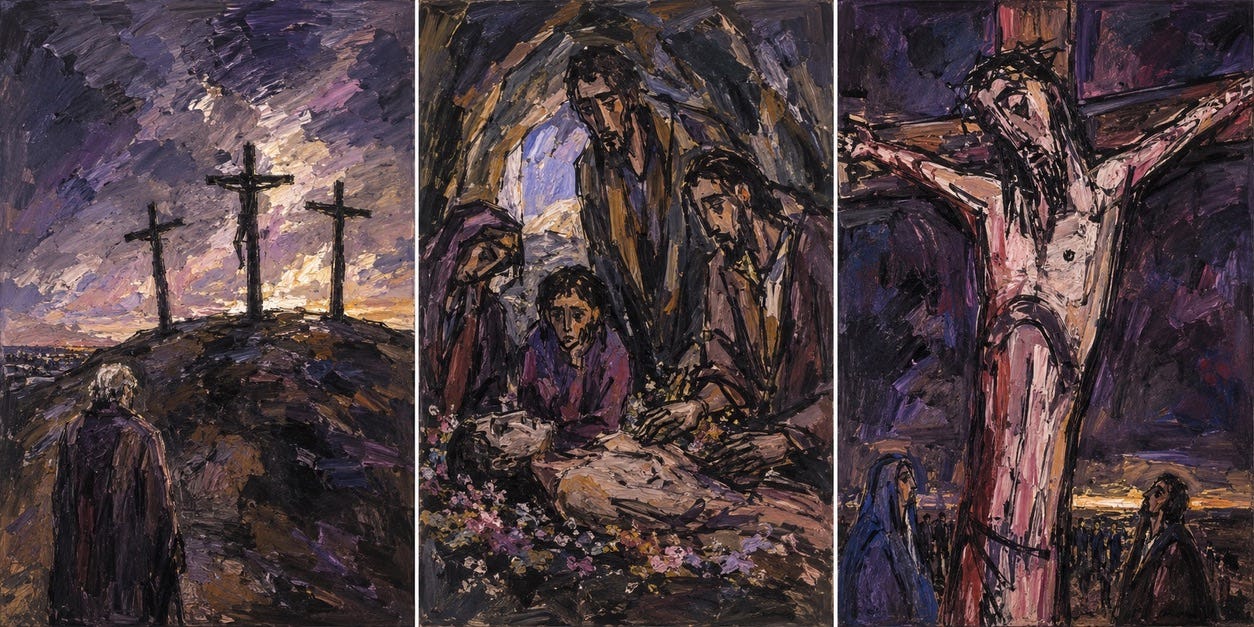
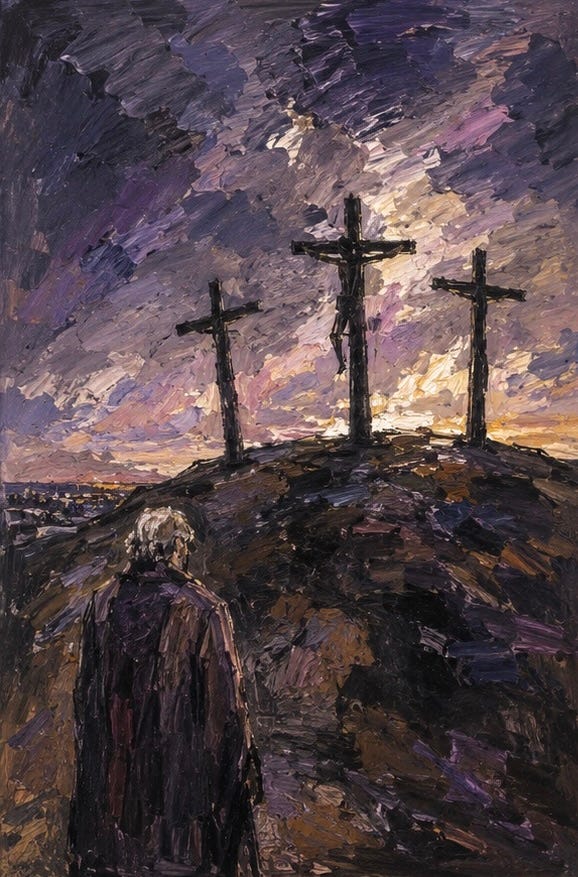
“You know, Father… I truly think most of humanity dies like Gestas.”
“Still angry?”
“Yes.”
“Still resisting?”
“Yes.”
“Still incapable of letting go?”
Bê nodded to himself.
“The human ego clings with astonishing force.”
Father Russo inhaled quietly from his cigarette.
“And Dismas?”
“A small minority.”
“Why?”
“Because in the end he opened his hand.”
Outside, the branches stirred like some distant nocturnal sea.
Suddenly Father Russo laughed softly.
“Do you remember church paintings from childhood?”
“What about them?”
“Christ is nailed to the Cross.”
“Yes.”
“The two thieves are often tied with ropes.”
“Yes.”
“Pure iconography.”
“Symbolism through images.”
“Yes.”
Bê remained silent for several seconds before smiling faintly.
“How extraordinary.”
“What is?”
“Christ held upon the Cross by love.”
Silence.
“The others held there by ropes.”
Father Russo did not answer. Rain touched lightly against the glass. Bé pulled the blanket slightly higher across his knees.
“Tell me something, Father.”
“Yes?”
“Human beings are very strange creatures.”
“Pourquoi?”
“We know with absolute certainty that we shall die, and yet we still wish to die beautifully.”
Father Russo laughed tiredly.
“That is human dignity.”
“Or vanity.”
“Perhaps both.”
Bê smiled.
“Even corpses are dressed elegantly before burial.”
“Yes.”
“Even in death people still straighten the collar.”
“You are becoming literary again.”
“No. I am simply old enough to find humanity amusing.”
For a long time neither spoke. Only the rain remained. The sound of a glass touching wood. The breathing of two ageing men at opposite ends of the Atlantic.
Then Russo asked quietly:
“Are you afraid of pain?”
Bê considered carefully before answering.
“Yes.”
“And yet you insist upon playing philosopher.”
“Philosophers fear morphine too.”
Father Russo laughed so hard that he began coughing. Bé laughed as well.
At a certain age laughter often ends in coughing. Eventually Bê spoke again.
“Do you know what frightens me most?”
“What?”
“Losing lucidity.”
Silence.
“No longer knowing who I am.”
Russo remained silent.
“One is speaking normally. Then the medication arrives. Then delirium. Then confusion. Then one becomes merely a piece of breathing flesh.”
Outside, somewhere in the darkness, a branch snapped quietly.
“That is what truly terrifies me.”
Father Russo answered slowly.
“And yet some people require morphine simply to endure suffering.”
“Yes.”
“Some can die only once consciousness has softened.”
“Yes.”
“Perhaps grace sometimes arrives through delirium.”
Bê smiled faintly.
“You are such a Jesuit. You can spiritualise anything.”
“And you materialise everything.”
“No. I am merely old.”
The rain outside gradually weakened. Bé stared at the almost empty cognac glass.
“Tell me something, Father.”
“Yes?”
“Christianity and Theravāda Buddhism really are astonishingly similar.”
“Again?”
“No. This time I am serious.”
“In what way?”
“They both seek the death of Dismas.”
Father Russo fell silent.
“Letting go.”
Silence.
“No more clinging.”
Silence.
“No more resentment.”
Silence.
“No more fear.”
Very softly Russo answered:
“In theology we call that abandonment.”
“In Buddhism one would call it loosening attachment to the self.”
“You truly are offensive towards every tradition equally.”
“No. I simply notice that all religions begin speaking the same language near the end of life.”
Outside, the rain had almost ceased entirely. The house seemed quieter now than earlier in the night. Bê suddenly felt a profound weariness within his chest, not dramatic, merely old, as though the body itself were gradually rehearsing departure.
Then he spoke softly, almost to himself.
“The hardest thing is not dying.”
Father Russo waited.
“The hardest thing is accepting disappearance.”
The silence from Paris deepened.
Only the breathing of two old men remained, suspended between Massachusetts and Paris like a fragile thread attempting to delay the void a few moments longer.
At length Russo spoke again.
“Do you think man can truly accept annihilation?”
Bê gave a dry laugh.
“No.”
“Then why speak constantly of letting go?”
“Because otherwise death becomes even more painful.”
Outside, rainwater continued falling from the roof in slow isolated drops upon the stone below.
“Today perhaps ninety-five percent of humanity possesses some form of belief,” Russo said quietly.
“Yes.”
“What does that suggest to you?”
Bê remained silent for some moments.
“That mankind cannot endure existence without imagining that something survives death.”
“The soul?”
“Or memory. Or Heaven. Or ancestors. Or Nirvana. Or reincarnation.”
“Symboles contre le néant.”
“Yes.”
Then Bê continued slowly.
“Perhaps civilisation itself is merely symbolic architecture erected around death.”
“You and your Shanidar again.”
“Yes. Shanidar again.”
Russo inhaled quietly.
“When I was young, I believed theology might save humanity.”
Bê smiled.
“And when I was young, I believed science might save humanity.”
“Et alors?”
“Now both of us are old.”
They laughed together once more, though this laughter sounded more exhausted than before.
Then Bê spoke again.
“Do you know what I find most curious?”
“What?”
“The older I become, the more the great religions seem to converge at the same point.”
“What point?”
“Death.”
Father Russo remained silent.
“Christianity speaks of mourir dans la grâce.”
“Yes.”
“Buddhism speaks of releasing attachment to the self.”
“Yes.”
“In the end every religion simply wishes to help man die slightly more gently.”
Outside the dark branches moved softly in the final wind after rain.
“Do you think most humanity succeeds?” Russo asked quietly.
Bê finished the last of the cognac and shook his head.
“No.”
“Why not?”
“Because the ego is too powerful.”
Silence.
“Human beings cling ferociously to themselves.”
Silence again.
“To money. To reputation. To love. To ideology. To memory. To the body itself.”
He paused.
“Even while dying, many remain furious.”
The line remained silent for a very long time. Then Russo asked in almost a whisper:
“Have you ever witnessed a beautiful death?”
Bê thought carefully.
“Yes.”
“Whose?”
“My mother’s.”
Outside, the wind ceased completely. The house sank into the soft silence preceding dawn.
“She knew she was dying,” Bé said quietly.
Silence.
“She did not cry.”
Silence.
“She did not philosophise.”
Silence.
“She simply asked whether everyone had eaten.”
Father Russo said nothing.
Bé looked down at his ageing hands.
“That was when I understood that a beautiful death is not heroic.”
Silence.
“It is simply the ability to continue loving others while one is disappearing.”
Paris remained quiet for a long while before Russo finally answered:
“That is almost the Christian definition of love.”
Bê smiled faintly.
“Or merely the instinct of mothers.”
They both laughed softly.
Then silence returned once more.
Old age often consists of nothing more than alternating between laughter and silence.
After some time Father Russo asked quietly:
“Do you pray?”
Bê frowned slightly.
“No.”
“Never?”
“No.”
“Not even when afraid?”
Bê looked out towards the darkness beyond the window.
“Father.”
“Yes?”
“I do not believe strongly enough to pray.”
Silence.
“But I understand why humanity must pray.”
Father Russo exhaled softly.
“There is an immense difference between those two things.”
“Yes.”
“A very great difference.”
Bê nodded to himself.
“And yet the older I become, the more I begin wondering whether God perhaps does not require belief as intensely as we imagine.”
The line fell silent again. Then Bê continued in a lower voice.
“Perhaps what He truly wants is simply that we become less afraid.”
Outside, the sky had begun to pale faintly behind the trees. Paris by now was certainly awake beneath the wet grey roofs of morning. Father Russo glanced at the time.
“I must go and say Mass.”
Bê smiled.
“And I must finally attempt sleep.”
“Bonne nuit, mon vieux.”
“Bonne messe, mon père.”
The line went dead. Immediately the room seemed larger with silence.
Bê remained seated for a long while beside the empty cognac glass, the telephone, and the faint reflection of his ageing face in the darkened window. And suddenly he understood that an entire human life might merely consist of searching for a way to die slightly less badly.