THE CRY (1)

To Rev. Russo sj.
FOREWORD
TWO OLD MEN AT THE END OF CIVILISATION
Perhaps this story could only occur near the end of a human life. Not the tragic ending of melodrama or hospital corridors, but that quieter ending in which one has lived long enough to watch the great systems of humanity begin ageing alongside one’s own body. Ideologies that once promised salvation. Philosophies that believed they could explain mankind. Theologies convinced they possessed absolute truth. After war, Auschwitz, Hiroshima, Darwin, Freud, Vatican II, existentialism, artificial intelligence, and neuroscience, all of them seem somehow more exhausted than before, like ancient stone churches beneath the winter rain of Europe.
Bê and Father Russo belonged to the last generation still raised with the belief that ideas might save humanity.
One moved gradually towards unbelief.
The other remained within the Church.
Yet old age had drawn them closer together than youth ever had.
Father Russo was a Jesuit priest in Paris. In his younger years he had written occasional essays for theological journals surrounding Christus, within that distinctly French Catholic intellectual atmosphere of the post–Vatican II years, where Teilhard de Chardin, Heidegger, Bernanos, Camus, and modern theology could still inhabit the same table amidst cigarette smoke and black coffee. It was a time when many Jesuits genuinely believed Christianity might still converse with Darwin, existentialism, and the nihilism of the twentieth century without surrendering its soul.
Bê had taken another path. He no longer possessed faith in the ordinary sense. Yet the older he became, the more he found himself drawn back towards the religions of most of humanity, as though returning to some ancient cemetery of civilisation itself. Not exactly to pray, nor to convert. He carried within him every conceivable argument for unbelief. He returned merely to observe how mankind had attempted to understand death across the centuries.
The two men were the same age. Both stood near the end of life. Both had read far too many books. And both understood that human history had never truly resolved its most fundamental terror: man knows that he will die.
Their conversations therefore no longer resembled the old quarrels between religion and atheism. They were too old for that now. The late-night telephone calls between Massachusetts and Paris sounded instead like the final seminar of an ageing civilisation attempting to delay the darkness through theology, philosophy, and fragments of elderly humour.
Some nights they spoke of Dismas and Gestas upon Golgotha. Other nights they argued about the purpose of Heaven itself, wondering what eternity might possibly mean if one were condemned to gaze endlessly upon the face of God. There were evenings when Bé asked how Hell’s fire might burn a soul without flesh. Other nights carried them from Adam and Eve to Darwin, from Eden to Shanidar, from the Crucifixion to artificial intelligence.
At times the conversations sounded almost absurd. At other moments they resembled humanity’s final colloquium before the void.
What troubled Bé most profoundly was the simple fact that nearly all humanity possessed some form of belief. Christianity. Buddhism. Islam. Heaven. Hell. Nirvana. Ancestors. Reincarnation. Souls. It seemed impossible for man to endure existence without erecting symbols around death.
Perhaps religion was never merely doctrine. Perhaps it was the manner in which an animal aware of its own extinction attempted to survive that knowledge.
Perhaps this was the true meaning of Original Sin. Not the eating of forbidden fruit within some mythological garden, but the moment humanity first understood its own finitude. An animal suddenly realised that it would vanish. From that fall emerged civilisation itself. Poetry. War. Religion. Money. Art. Memory. Redemption.
Father Russo called this grace. Bê called it the tragedy of consciousness.
Yet both sensed that every great civilisation ultimately revolved around one question alone: how does man die once he knows he is about to disappear?
Some die like Christ, accepting sacrifice. Some die like Dismas, opening their hands at the final moment. Some die like Gestas, bitter and mocking until the end.
And most of humanity, Bê believed, dies somewhere between those three crosses.
1
THE THREE MEN UPON GOLGOTHA
The Massachusetts night was colder than usual. Bê sat alone in the sitting room, his legs covered by a thin grey blanket, beside a cup of tea already half cold. The clock upon the wall had passed two in the morning. The house was so silent that he could hear the faint vibration of the refrigerator in the kitchen, like some elderly animal breathing in its sleep.
He could not sleep.
At a certain age insomnia ceases to be insomnia. It becomes a kind of natural vigil maintained by the body before the darkness.
He reached for the small lamp beside the armchair. Its yellow light settled gently across old books, a forgotten Nana Mouskouri record still lying upon the table, and a pair of slippers placed neatly beneath the chair. Outside, the night wind stirred the trees with a sound resembling sheets of paper rubbing together within an abandoned library.
He took up an old French New Testament. The corners of the cover had worn soft with age.
He opened directly to Golgotha. Then he smiled quietly to himself.
“How strange,” he murmured. “The whole civilisation of the West revolving around an execution.”
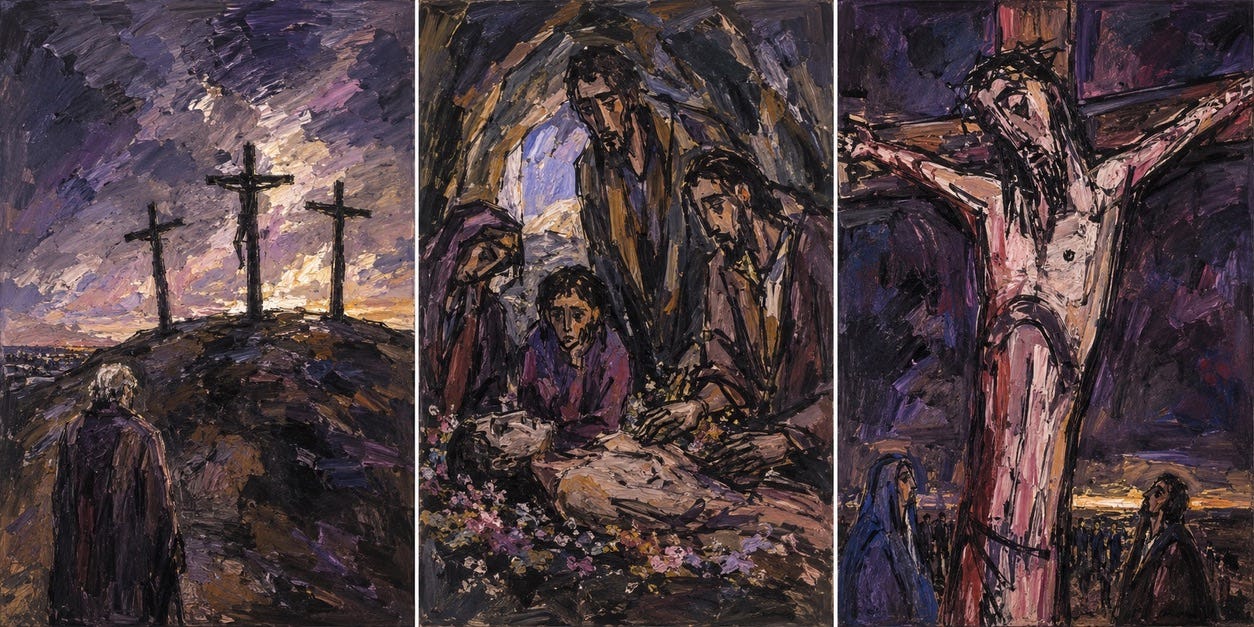
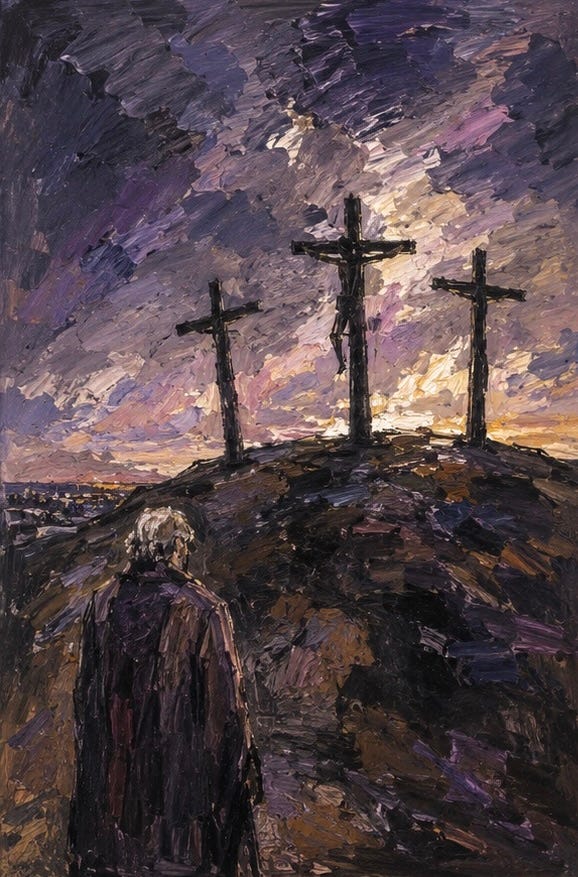
He read slowly for several moments before letting the book rest upon his knees. Upon Golgotha that day there had been three men suspended upon crosses. Jesus in the centre. Two thieves at either side.
One would be saved. The other would curse until the final moment. Bê frowned slightly.
“Curious…”
Then he reached for the telephone and dialled Paris with deliberate slowness, as though performing an old ritual repeated for many years.
The ringing continued for some time before a voice finally answered.
“Allô…”
Father Russo’s voice still carried the thickness of sleep and tobacco. Bê laughed softly.
“You are not dead yet, Father?”
A dry laugh emerged from Paris.
“Not yet. Though I am approaching the matter.”
“Bonne nouvelle.”
“And you?”
“I am reading the New Testament at two in the morning. The situation is becoming serious.”
Father Russo sighed.
“Mon Dieu… we truly are old.”
Outside the window the wind continued moving through the trees. Bê drew the blanket slightly higher across his knees.
“Tell me something, Father. How many people were truly present upon Golgotha that day?”
Russo laughed faintly.
“Three.”
“No. Four.”
“Barabbas?”
“Yes.”
“Barabbas was not crucified.”
“Precisely. That is why he matters.”
Several seconds passed in silence.
“You are beginning again,” Russo said.
Bê smiled.
“I merely observe that had the crowd chosen differently, Christianity itself might never have existed.”
A faint cough sounded across the Atlantic.
“You remain a profoundly dishonest unbeliever.”
“No. I am speaking of contingence historique.”
“Do not become Heidegger at two in the morning.”
Bê laughed softly.
After a long pause he continued.
“What fascinates me most is that the original Gospel never names the two thieves.”
“Yes.”
“Dismas and Gestas came later.”
“Yes.”
“How remarkable.”
“What is remarkable?”
“That man cannot endure anonymity before death.”
Father Russo said nothing. Bê continued.
“Three men dying side by side upon a hill without names would have been intolerable. So humanity gave them names. Stories. Symbols.”
A lighter clicked faintly in Paris.
“A symbol does not mean falsehood.”
“All priests say that.”
“Because it is true.”
Bê looked at his own reflection upon the darkened glass.
“Dismas…”
He spoke the name almost to himself.
“A dying thief who finally opened his hand.”
“And Gestas?”
“He died angry.”
Father Russo inhaled from his cigarette and spoke quietly.
“Three manners of dying.”
“Voilà.”
“Christ dies accepting sacrifice.”
“Yes.”
“Dismas dies in hope.”
“Yes.”
“Gestas dies in bitterness.”
Bê remained silent for a long time.
Outside, a dry leaf turned beneath the wind before becoming still once more.
Then he spoke slowly.
“You know, Father… I suspect most of humanity dies like Gestas.”
Silence again. Bê continued.
“In pain. In panic. Furious. Unable to accept disappearance.”
Russo answered gently.
“And Dismas?”
“A small minority.”
“And Christ?”
Bê gave a dry laugh.
“Do not force me into theology at two in the morning.”
Father Russo laughed as well. The laughter of two old men travelled thinly across the Atlantic cables. After some time Russo asked:
“Do you believe Dismas was truly saved?”
Bê looked at the cold tea beside him.
“I do not know.”
“But?”
“I think the story beautiful.”
“Only beautiful?”
“Yes.”
“Not true?”
Bê shrugged, though the other man could not see him.
“Father… nearly all humanity believes in something. Christianity. Buddhism. Islam. Ancestors. Heaven. Reincarnation. Nirvana. Everything revolves around death.”
Russo remained silent.
“It seems impossible for mankind to survive without constructing symbols around the void.”
Symboles contre le néant.”
“Exactly.”
Bê smiled faintly.
“Perhaps civilisation itself is merely symbolic architecture erected against death.”
A cup touched lightly against a table somewhere in Paris. Father Russo was likely pouring coffee.
“You remain a child of Shanidar.”
“And you remain a child of Golgotha.”
They laughed together once more, though this laughter was gentler than before. At a certain age people laugh almost as though apologising to life.
After a long silence Bê continued.
“Tell me something else. If one examines carefully enough, Christianity and Theravāda Buddhism both seem directed towards the same manner of death.”
“What manner?”
“The death of Dismas.”
Father Russo fell silent.
“Letting go?”
“Yes.”
“No longer clinging?”
“Yes.”
“No longer bitter?”
“Yes.”
Outside, the wind moved through the trees like the sound of some distant sea.
“In theology,” Russo said slowly, “we call this mourir dans la grâce.”
Bê laughed softly.
“In Buddhism one would call it releasing attachment to the self.”
“You are equally disrespectful towards every religion.”
“No. I am simply old enough now to notice how similar they become.”
Silence settled again upon the line. Bé glanced at the clock. A quarter to three. Suddenly he felt exhausted, not merely tired but old in the deepest physical sense, as though his body were slowly learning how to depart from the world.
Then Father Russo asked quietly:
“My old friend… how would you wish to die?”
Bê remained silent for several seconds. Then he smiled faintly.
“Comfortably, of course.”
They both fell silent.
Because both men knew that nobody controls death. Outside, the dry leaf turned once more beneath the wind. And the night continued ageing quietly around them.
To be continued …